

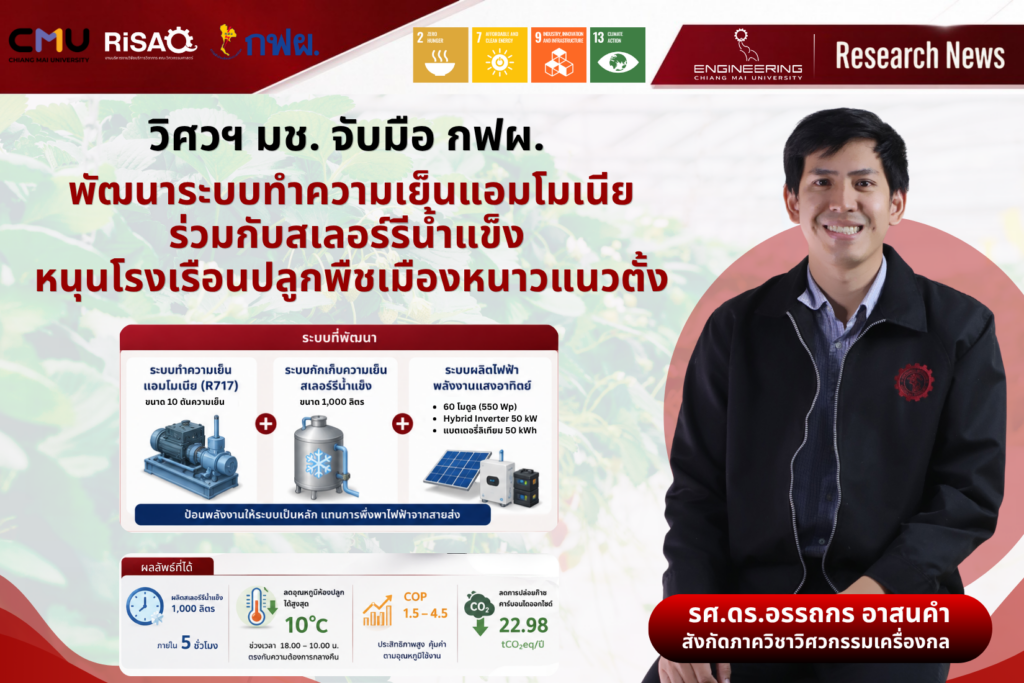
การปลูกพืชเมืองหนาวในประเทศไทยมีข้อจำกัดสำคัญคือความต้องการอากาศเย็นต่อเนื่อง ซึ่งแลกมาด้วยต้นทุนพลังงานที่สูง คณะวิศวกรรมศาสตร์ มหาวิทยาลัยเชียงใหม่ ร่วมกับการไฟฟ้าฝ่ายผลิตแห่งประเทศไทย (กฟผ.) จึงได้ดำเนินโครงการ “การพัฒนาระบบทำความเย็นที่ใช้แอมโมเนีย (NH₃) เป็นสารทำงานร่วมกับการกักเก็บความเย็นด้วยสเลอร์รีน้ำแข็งสำหรับโรงเรือนปลูกพืชอุณหภูมิต่ำในแนวตั้ง” ภายใต้การสนับสนุนของกองทุนนวัตกรรมสำหรับอุตสาหกรรมทำความเย็น (EGAT Cooling Innovation Fund: CIF) โดยมี รศ.ดร.อรรถกร อาสนคำ ภาควิชาวิศวกรรมเครื่องกล เป็นหัวหน้าคณะทำงานวิจัย ร่วมกับ ศ.ดร.ทนงเกียรติ เกียรติศิริโรจน์ และ รศ.ดร.ธรณิศวร์ ดีทายาท พร้อมคณะทำงานจากทั้งสองหน่วยงาน
จุดเด่นของงานวิจัยคือการผสานเทคโนโลยีสามส่วนเข้าด้วยกัน ได้แก่ ระบบทำความเย็นแอมโมเนีย (R717) ขนาด 10 ตันความเย็น ระบบกักเก็บความเย็นในรูปสเลอร์รีน้ำแข็งขนาด 1,000 ลิตร และระบบผลิตไฟฟ้าพลังงานแสงอาทิตย์ขนาด 60 โมดูล (550 Wp) ร่วมกับไฮบริดอินเวอร์เตอร์ 50 kW และแบตเตอรี่ลิเทียม 50 kWh เพื่อป้อนพลังงานให้ระบบเป็นหลักแทนการพึ่งพาไฟฟ้าจากสายส่ง ผลการทดสอบพบว่าสารผสมน้ำกับเอทิลีนไกลคอลที่สัดส่วน 8 wt% ให้อัตราการแข็งตัวเร็วที่สุด โดยระบบสามารถผลิตสเลอร์รีน้ำแข็งครบ 1,000 ลิตรได้ภายใน 5 ชั่วโมง มีค่าสัมประสิทธิ์สมรรถนะ (COP) อยู่ระหว่าง 1.5–4.5 ตามอุณหภูมิแตกต่างระหว่างคอนเดนเซอร์และสารผสมในถังกักเก็บ และเมื่อนำความเย็นที่กักเก็บไว้มาใช้ปรับอากาศ สามารถลดอุณหภูมิห้องปลูกพืชแนวตั้งลงได้ถึง 10 องศาเซลเซียส ครอบคลุมช่วงเวลา 18.00–10.00 น. ซึ่งตรงกับความต้องการอากาศเย็นในเวลากลางคืน นอกจากนี้คณะผู้วิจัยยังได้พัฒนาแบบจำลองทางคณิตศาสตร์สำหรับทำนายอุณหภูมิสารผสมและกำลังไฟฟ้าที่ผลิตได้ ซึ่งให้ผลสอดคล้องไปในทิศทางเดียวกับการทดสอบจริง
ระบบดังกล่าวได้ติดตั้งใช้งานจริง ณ โรงเพาะปลูกพืช ต.บ้านดง อ.แม่เมาะ จ.ลำปาง และจากการประเมินพบว่า การนำระบบมาใช้ในกระบวนการกระตุ้นตาดอกสตรอเบอร์รีตลอดระยะเวลา 1 ปี สามารถลดการปล่อยก๊าซคาร์บอนไดออกไซด์ได้ 22.98 tCO₂eq ต่อปี งานวิจัยนี้จึงเป็นอีกหนึ่งตัวอย่างของการนำองค์ความรู้ด้านวิศวกรรมทำความเย็นและพลังงานทดแทนมาตอบโจทย์เกษตรกรรมมูลค่าสูง พร้อมทั้งเปิดโอกาสให้เกษตรกรไทยเพาะปลูกพืชเมืองหนาวได้กว้างขวางขึ้น ควบคู่กับการลดการปล่อยก๊าซเรือนกระจกอย่างเป็นรูปธรรม
CMU Faculty of Engineering and EGAT Develop Ammonia-Based Refrigeration System with Ice-Slurry Storage for Vertical Low-Temperature Farming
Growing temperate crops in Thailand demands continuous cold air — and with it, a heavy energy bill. To address this, the Faculty of Engineering, Chiang Mai University, in collaboration with the Electricity Generating Authority of Thailand (EGAT), has completed the research project “Development of a Refrigeration System Using Ammonia (NH₃) as Refrigerant with Ice-Slurry Coolness Storage for Growing Low-Temperature Plants on a Vertical Farm,” supported by the EGAT Cooling Innovation Fund (CIF). The work was led by Assoc. Prof. Dr. Attakorn Asanakham of the Department of Mechanical Engineering, together with Prof. Dr. Tanongkiat Kiatsiriroat and Assoc. Prof. Dr. Thoranis Deethayat, alongside a joint research team from both organisations.
The project’s distinguishing feature is the integration of three technologies into a single system: a 10-ton-of-refrigeration ammonia (R717) unit, a 1,000-litre ice-slurry coolness storage tank, and a solar power system comprising 60 modules of 550 Wp each, paired with a 50 kW hybrid inverter and a 50 kWh lithium battery bank, which supplies the majority of the system’s electricity in place of grid power. Testing showed that a water–ethylene glycol mixture at 8 wt% produced the fastest ice formation, enabling the system to generate the full 1,000 litres of ice slurry within five hours, with a coefficient of performance (COP) ranging from 1.5 to 4.5 depending on the temperature difference between the condenser and the storage tank. When the stored coolness was released for air conditioning, the vertical grow room temperature dropped by as much as 10 °C, covering the period from 18.00 to 10.00 — precisely when cool air is required overnight. The team also developed a mathematical model to predict the storage fluid temperature and solar power output, which showed trends consistent with the experimental results.
The system has been installed and commissioned at a plant cultivation facility in Ban Dong Subdistrict, Mae Moh District, Lampang Province. Assessment indicates that applying the system to strawberry flower-bud induction over one year can reduce carbon dioxide emissions by 22.98 tCO₂eq per year. The project stands as a practical example of applying refrigeration engineering and renewable energy expertise to high-value agriculture — widening the opportunity for Thai farmers to cultivate temperate crops while delivering measurable reductions in greenhouse gas emissions.
EngineeringCMU #CMUResearch #กฟผ #CoolingInnovation #VerticalFarming #SmartAgriculture #NetZero
